Tuesday, September 27, 2022

CAGD 270 Simple DnD Map v3

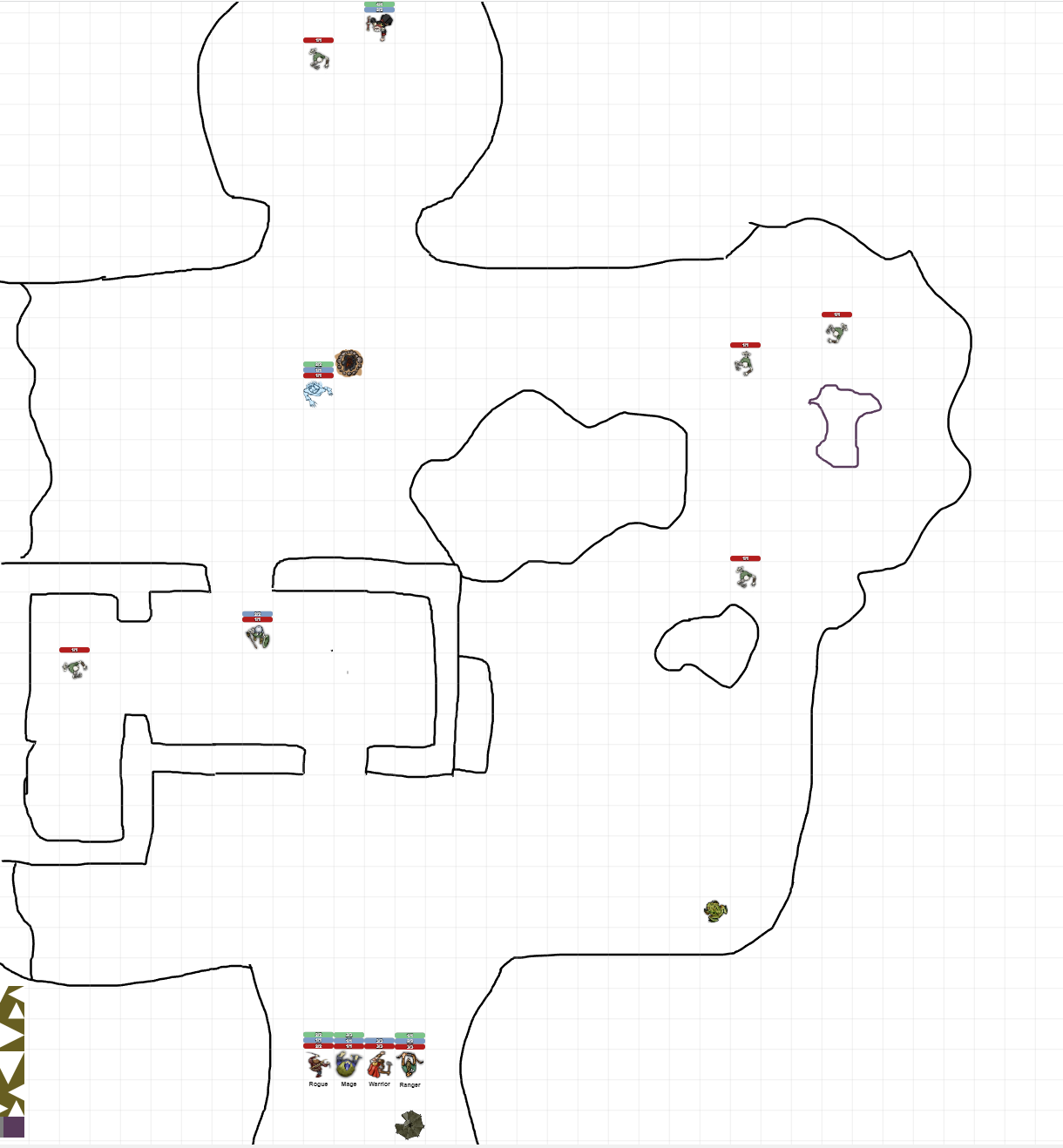
 For the Simple DnD Map v3 assignment, Valerie played the rogue and Kyle played the ranger. Because of the new rulesheet and theme, I designed a completely new level. The theme was an alien prison break, and the new rules changed the stats and replaced skills with items. 

The starting room is the armory of the prison, giving the players three treasure chests right off the bat. One chest will contain one of four possible items used to unlock doors or cross gaps: the lockpick, c4 explosive, photon bridge, or relocator. Another one will give one possible defensive item, either a medkit, shoulderplates, or a gabapentin shot. The third chest has a random assortment of items. 

With this equipment, the players exit into the first encounter: two escaped convicts. They’re simple and easy. From there, there’s a shortcut if players can get through a vent grate. Players can unlock it with the lockpick, or blow it open with the c4, or teleport to the other side with the relocator. If they do not notice it, they head into the next encounter in a big open room. There’s a pit in the middle that can be crossed with the photon bridge. There’s two ranged prison guards, so players will have to use cover as they work their way closer if they can’t cross the pit. There’s also another vent that lets the players sneak into the lower area, past this encounter, if they can open it. The last thing of note in the second encounter is a chest that will provide one of three weapons. 

If the players go down, they can find a chest with armor in it, a chest with another lockpicking item, and another encounter with two escapees and one melee prison guard. If they go right, they can find the medbay, where there’s a ranged guard and a tough melee guard. There’s two chests with an armor set and a healing item. Behind the tough guard is a big locked door and another pit. This indicates where the players are supposed to go next. After getting past it with one of their lockpicking items, the players will encounter the boss.

The boss arena has lots of chasms, which will be to his benefit (or the player’s if they can cross them). The warden boss has two abilities. First, he can dodge up to three times, which negates 1d8 of damage from an attack and then relocates up to seven tiles away. Second, his forcefield gives him three bonus defense against ranged attacks. 


The players in the playtest breezed through the first encounter. They used the c4 to open the vent shortcut and went to the medbay. The prison guards gave them some trouble and they had to use some healing items. They got some more equipment, giving a regenerating armor to the rogue. They then used the photon bridge to cross the gap around the door to reach the boss fight. 

The rogue rushed the warden boss, who dodged two of her attacks. The ranger threw the c4 at the warden for a large amount of damage. The rogue used her armor and the gabapentin to sustain against the damage from the warden’s attacks. Realizing ranged attacks wouldn’t work very well, the ranger finished off the boss with a melee attack. 

The players really liked the variety of items. They also liked getting to use the lockpicking items to interact with the environment. They found the boss fight engaging and challenging. They also found that the vent passages made things pretty fast, although that’s the only way we completed things within the time limit. 


I think it went very successfully. I think the only changes I would make would be some rebalancing on the boss’s defense, since the c4 did a lot of damage to him. While this was resourceful of the players, I think it was just a little too effective, so I would probably count it as a ranged attack and therefore increase the warden’s resistance to it. 


Tuesday, September 20, 2022

CAGD 270 Simple DnD Post-Mortem v2

 For the second iteration of my Simple DnD assignment, I made several modifications. Mainly I improved the visuals to make it clearer where the level bounds are. I added two new enemies: one weak enemy in the right path, and one medium enemy in the middle. I also got better graphics for the chests. 

The structure remained the same, featuring two initial paths: the house with a locked door, and a path through the forest. Either one of these will be the first encounter. Both exit into the same place, the second encounter, which leads into a cave with the boss inside.

For the playtest, Valerie played as a mage and Kyle played as a rogue. They picked the right path this time instead of the left one. They made quick work of the easy enemies, each one dying in one or two attacks. I think this was the perfect balance for this encounter. They got an upgrade scroll from the treasure chest. The second encounter was more difficult. When enemies get lucky rolls it does a lot of damage to the players. They were successful, but it was closer than I would have liked it to be. While part of it is just the nature of dice rolls, I might want to make the ghoul enemy do less damage. The boss fight also proved challenging for the players. They had less treasure as a result of taking the right path instead of the left. They were successful as well, but I might decrease the magic damage of the boss.


What went right?

The first encounter was balanced really well. Players appreciated the improved visual clarity of the level. Players liked treasure. They completed the level a little under the time limit, so the length seemed perfect. The boss was challenging and presented them with interesting choices. The lich summons skeletons or performs a ranged magic attack each turn. Each player will choose to either focus the summoned enemies or attack the boss, or try to maneuver around the summoned enemies to reach the boss.

Because of the two splitting paths, they got to see a different area of the level this time, making a simple but somewhat custom experience. They still got to use the lockpicking skill on the chest in the middle.


What went wrong?

Some lucky enemy dice rolls left the players at low health. This included the ghoul and the lich. It didn’t happen as much with the weaker enemies since they had melee attacks. 

Also, the players didn’t get to utilize jumping. They only got one chest as a result of the path difference, which meant only one of the players got treasure.


For changes, first I would decrease the magic attack of the ghoul and lich. I might also add a shield item to the chests. Another chest on the right path would be an improvement 

Players didn’t get to utilize jumping, so I think a good addition would be a river to jump over dividing the forest from the second encounter. Regardless of which path the players take, they either jump over to reach the second encounter or jump over the gap to get the treasure chest.

I might also open up the Lich’s cavern more to add more space, or gaps to jump over. 


Tuesday, September 13, 2022

CAGD 270 Simple DnD Postmortem

 For my Simple DnD Map playtest on September 13, I designed a simple DnD level consisting of four encounters. The level was designed to start with a player choice to go into a fortified house or take a longer path through the forest. The house held one locked door, one strong enemy, one weak enemy, and a treasure chest. The forest path held three weak enemies. Both paths exited to the next open area that has one strong enemy and one treasure chest. For the last encounter, players would proceed into a cave for the boss fight.

Since the rulesheet mostly discussed combat mechanics, I figured that a good tutorial level would feature some simple encounters to get players accustomed to it. Each encounter had a small number of overall enemies, no more than three, and none of them were especially powerful. Some had more defense, but none had high offense besides the boss. 

For the playtest I was in a group with Kyle, who picked the Mage class, and Valerie, who picked the Ranger class. First, they entered the house by unlocking the locked door. They killed the enemies inside very quickly, and found the treasure chest hidden in its back room. Valerie got to it first and was rewarded with a health potion. I added this to the game to introduce it as a mechanic and keep things easy. They proceeded to the next encounter, which they also ended in a single turn. Kyle got to the second chest and found an enchantment scroll, which let him choose one stat to increase. They ended the adventure with the boss fight, who could summon weaker enemies to fight, and use strong magic attacks. They dispatched the boss in a few turns, and struggled more to deal with the summoned enemies. However, they were successful.


What went right?

The players enjoyed the simple dramatic element of having to fight a necromancer to avenge your father. They seemed to enjoy finding items in treasure chests. The final boss went well, being somewhat challenging but ultimately ending with them succeeding. The challenge was important as it made the players consider their combat options. They engaged with the majority of the combat mechanics, such as attacks, magic attacks, positioning, and healing from damage. 


What went wrong?

The thing I noticed most was that they ended most encounters in a single hit with some lucky dice rolls. I think my strong enemies needed more defense, or just to have more of them. This may however been due to class balance, since they both picked characters with high range. The players also noted that the level bounds should’ve been more visibly clear on the map. Graying out the out of bounds area would have added to my level. 


For other additions, players didn’t get a chance to use the jumping skills. An improved version of the level would have some gaps or obstacles to jump over. 

Overall, players had an easy time figuring out where to go. They enjoyed a lot of my additions, such as the items and final boss. However, they didn’t end up using the health potion. Because item usage is mentioned in the rulesheet, I could’ve added another possible potion, such as strength, that would encourage players to use it actively rather than reactively. 

Other than that, I think the level was mostly successful at easing the players into combat. With some encounter rebalancing to create a smoother difficulty curve, and some obstacles to jump over, I think it would be very well off. 


Wednesday, May 18, 2022

CAGD 112 Eporfolio 2


Flipbook

I can't embed the video because of the file size, so here's the first frame of the video. For the Flipbook assignment, we took hundreds of pictures and played them rapidly to create the illusion of motion. I used a monkey figure and some playing cards to make it look like the monkey is playing a game of solitaire. As I don't have a tripod, getting the setup right was tricky as I was limited to just what I had in my dorm room. If I could move the camera, I would prefer a more higher angle to view the cards better. 

Hyper-Realism


For the Hyper-Realism assignment, we used a variety of digital editing effects to combine our source files into a hyper-real result: something that can't feasibly exist in real life. I edited this statue to make it appear as if it is coming out of a stone wall. I also edited the holes from the tree to make it look like the wall was full of tiny holes. My goal was to make something that looks creepy, and I think I succeeded.

Portrait


For the portrait assignment, we had to take a portrait of someone, so I asked my roommate to help be my subject. The editing for this was fairly simple compared to the other projects, I just adjusted the color values of the image to make the reds stand out more and the greens be slightly duller. I also increased color contrast on the subject to make him stand out more. 


Friday, May 13, 2022

CAGD 170 Unit 3 Postmortem

 For Unit 3 I was part of Group 6, and we made the game "Capital March." The core elements of our game are based around a map of the US states where players buy up senators, using money they earn on the stock market, and manipulating the game through elections. Because our game is very strategy-based, we aimed for those types of players like the Competitor or the Director. For the age demographic we were thinking older than 12, since the subject matter probably would probably be more interesting to people who understand the US government. 


The first elements of the game we developed were the map and choosing where to start, then expanding. There are 2 buyable senator tokens per state, and players expand out from where they start to try to control as much of the board as possible. We built in the money system to go with this. We planned for players to have a sort of auction if they're competing over the same senator where it goes to the highest price, but later in development realized that was hard to keep track of, so we fixed this problem with stacking the senator tokens to indicate how many times it's been bought (and therefore how high the competitive price should be). We wanted to give players lots of different strategic choices, and this system succeeded at that right away by letting players pick where to start and where to expand to. Players can also choose to buy the second senator of a state to reinforce it, though later on we made this a bonus move that doesn't take up a turn since the lack of expansion otherwise makes it less effective than buying one in a new state. 

The stock market came in pretty fast after our money system. We came up with the idea of using tokens to represent how much stock players have as a good representation of value. For balancing it we changed the numbers a few times, but generally wanted stocks to rise on average (with about a 66% chance to go up each turn) so that way they're worth using. This is reflected by how inflation in the real world means that putting value in assets makes it more resistant to inflation and therefore more valuable. 

All of those mechanics were ones we had planned out from the start. My partner came up with the initial idea of the subject matter of the game, money and corruption of politicians, and I came up with a lot of the early skeleton (100 senators, money, stocks). After some playtesting we liked this game but still felt it was too simple and didn't have enough to mix things up or keep it interesting. So in a later version, we had the idea to add elections.

Elections reward players for spreading wide but having deadlocked states gives risk to players who don't double-up their states. The balancing of this was pretty intricate, but mostly came from thinking of simple solutions to different contingencies (such as if a state has one of each senator, who does the vote go to?). An integral part of this system is that votes can be bought for cheaper than the price of a senator both lets players make comebacks as well as lets players make risky plays through elections and have access to them earlier. After some testing and development, we made it span over multiple turns so that way the starting player has less of an advantage because now there's room for 2 turns of back-and-forth between the players. The elections pretty naturally tied into the stock market, which integrated everything together excellently as we now had 3 different systems that fed into each other. You use stocks to get money, you use money to buy senators and votes, you use senators and votes to win elections, you use elections to improve your stocks. 

One final addition we made was a bonus election result which is the choice to call a recess and skip a few turns. The idea behind this was to prevent long, drawn-out games by letting a player with a lead speed things up to put pressure on the other player. This pressure hopefully forces a confrontation.

Friday, April 29, 2022

CAGD 170

The group I partnered up with for our Unit 3 Playtest made a game called Gold Rush, which was the first one I play-tested with my partner. It was a pretty fun game to playtest, and we were able to get it moving pretty quickly once we started playing.

When reviewing it to give them feedback, one of the first things I did was run some probabilities. In the game you receive amounts of gold by rolling dice, and I was really struggling to get anything. However, upon doing the math, it seemed to be about a 50/50 chance every time you roll, so I was just getting unlucky. However, there were upgrades to assist with this issue, but all of them costed more gold than I was getting. As my partner realized, with his luckier rolls he didn't really have a need for them. So through our testing of the emergent properties of the game, we found that the pretty narrow price range for their shop was too steep a price for struggling players to have access too, but for well off players it was more worth it to just save your money for the win condition of getting 200 gold. However, I praised a lot of the upgrade designs, with some good variety as well as good limits and breakers (for example, increasing your storage space per mining trip to allow players to possibly return with more gold each time to catch up).

  • For the players of the game, it's two-player and player-versus-player. 
  • The objective is to get 200 gold. 
  • The procedures are rolling dice and using a spinner to return gold, as well as buying items from a shop. 
  • The rules determine how much gold is given based on each roll and the utilities of the shop items. 
  • The resources are gold and shop items. 
  • The conflict is that the game is a race between players, as well as being able to buy items that sabotage the other player. 
  • The boundaries are fairly abstract, but mainly encompass the two actions you can do as well as the limit on how much gold you can make per turn.
  •  The outcome is based on which player wins by completing the race first.
Another game I checked out was called Traveler. I really liked its formal elements of progressing along a board with random encounters, and I really liked a lot of the random encounter cards, with lots of interesting mechanics and variety. The major criticisms I had of it was mostly consistency in its terms and definitions. For example, it used the term curse to refer to a couple different mechanics and didn't really define how it worked as far as I could tell. It also had characters choose one of three classes at the beginning of the game but didn't explain how this changed gameplay. I also assumed players moved along one space at a time, but it's possible there was a different mechanism; however it wasn't immediately obvious on the rule sheet like basic mechanics should be. I still enjoyed reading through everything and think the game has a lot of potential for our next two revisions.

One last game I checked out was called Fury, a player-versus-player fighting game where players can choose to attack or protect specific points of their body. The premise for this game is really cool to me, as well as the main mechanics of allocating different points (distributed by drawing cards) to different limbs or organs to defend yours or attack your opponents. Overall I really liked this one, with my only criticism being some specific organization on the rule sheet.

Sunday, April 10, 2022

CAGD 170 Unit 2 Postmortem


For Unit 2, I was part of Group 5. For our project, we had to create a two-player board game themed around fast food in the rhythm genre, aiming at a target age range of 30-40 year olds. We made our game, "Corporate Chaos" as a player-versus-player board game in which players attempt to capture their opponents pieces under a restrictive time limit. Players can combine their own pieces to make 15 unique combinations to choose from, as well as pick up to 6 pieces to add to the board over the course of the game. Our timing system is a playlist of 90s music (to hit the 30 to 40 demographic) of at least 7 songs, in which players can add a new piece at the start of each new song, and the winner is the player with the most points awarded for capturing pieces at the end of the playlist. 

When it came to designing the game, we only encountered one major problem. That was playtesting, which was really hard in an online environment. One of the reasons we were inspired by chess is the way that people used to play it across great distances through letters; because every spot on the grid can be expressed by a letter and a number, if two people each set up their own board, it's super easy to communicate your moves to the other person (ex: Knight to E5) and have them understand and replicate what you're doing. We were able to get in a few viable playtests in this way. However, it was still substantially more difficult and less than we would've been able to do in an in-person class. Online, we had lots of limiting factors like printer access, physical desk space, and especially time. 

Despite that, I think we were able to create an effectively designed game. We focused on making a game that's easy to understand, and that stayed throughout. Our rule sheet is only two pages, and the setup and playing of the main game is described in only 5 paragraphs. We increased the complexity with each version, I think to the benefit of the game. The early versions, however, weren't nearly as interesting or unique because of this. We tried to focus on only a few mechanics that are versatile enough to make up a whole experience. 

The development process was pretty easy for us, considering that we kept in mind that we wanted to keep it straightforward and focus on only a few central mechanics. By the final version, this ended up being: adding elements as the timer progresses, and combining pieces. We both knew that giving players meaningful choices makes for a fun game, so we made these elements as customizable as possible. Players get to pick one of 3 unique pieces with 2 copies each to place anywhere in the back row of the board. That's already 24 possibilities. With combination pieces, we originally only had the Pizza Hut and Taco Bell pieces combinable. However, we realized for the final version that the game would be more interesting if the players could combine any two pieces. This results in 15 different possible combined pieces (although some may be better than others). Either way, the player has a lot of choice in how they set up their pieces. 

On our first playtest, we found that the game was too slow, and we were nowhere near done by the time the playlist was up. So we replaced the original objective of capturing the king with a "most points wins" objective instead. We then assigned each piece point values. We did this to encourage players to be more aggressive and make riskier plays, making the game more exciting and frantic and improving its pace.

Featured Post

Aftershock Simulator Sprint 3

This is th e tutorial video I made for my team demonstrating how to use the objective system I designed this sprint. I’m really happy with h...